Focused Ultrasound: A Novel Approach to Pain Relief
Cite as: Yaras R, Singla P, Kohan L. Focused ultrasound: a novel approach to pain relief. ASRA Pain Medicine News2025;50. https://doi.org/10.52211/asra080125.009.
Introduction
High-intensity focused ultrasound (HIFU) has been a promising non-invasive procedure for treating various medical conditions. Providers can concentrate acoustic energy and produce a localized thermal lesion through a plane transducer and an acoustic lens focusing bowl.1 (Figure 1A and B)

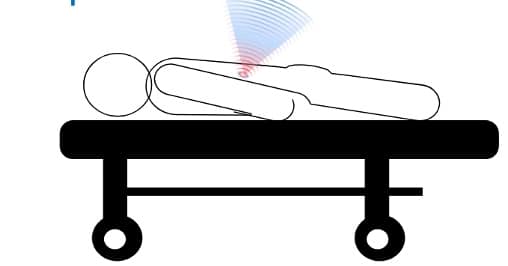
Therapeutic effects of HIFU were first described in medicine as early as the 1930s, and the procedure gained notoriety during World War II for its ability to sample localized brain lesions.2 Subsequently, its usage was at a standstill for many years due to its inability to focus precisely on one target. However, that all changed in the 1990s when K. Hynynen et. al. combined HIFU with magnetic resonance imaging (MRgFUS) to guide and monitor tissue damage.3
The development of image guidance propelled the clinical usage of HIFU to new heights. Since then, HIFU has been FDA-approved for numerous conditions, including but not limited to, cancer therapy, uterine fibroid ablation, glaucoma relief, essential tremor, and Parkinson’s disease.4 While fields such as neurology, oncology, obstetrics, and cardiology have seen significant advancements due to the development of HIFU,5 its usage in pain control remains less well-known. HIFU is currently used for cancer pain, chronic musculoskeletal pain, and neuropathic pain. This overview highlights the current research, usage, concerns, and future of HIFU for musculoskeletal pain.
Low back pain is another common condition that is being investigated for the use of HIFU.
Mechanism of Action
While the exact mechanism is unknown, it is believed that HIFU acts on hypersensitive nerve fibers and causes denaturation of increased neurotransmitters at the target site.6 The degeneration of nociceptors and primary afferent sensory nerve fibers on the bone surface alleviates pain. Other research shows there may be a temporary distortion of the stretch-activated ion channels present on the surface of neurons, thus potentially inducing a transient neuromodulation of both the central and peripheral nerves.7
Applications in Pain Medicine
HIFU is most notably used today for pain relief for those suffering from chronic knee pain secondary to osteoarthritis. Izumi et al. looked at using MRgFUS for those with severe medial knee pain associated with radiological osteoarthritis in 2013. The target for sonication was the bone surface just below the rim osteophyte of the medial tibia, which is the insertion site of the deep medial collateral ligament.8 The authors found that 75% of patients reported immediate pain alleviation after the procedure, and 50% reported long-lasting effects at 6-month follow-up.8 Notably, no side effects were reported, and the procedure was done without the requirement of intravenous sedation or opioid administration. Similar results were seen by Namba et.al. in 2019. The target in this study was the bone surface at the region of maximum tenderness on the inner side of the tibiofemoral joint.6
Low back pain is another common condition that is being investigated for the use of HIFU. (Figure 2) Common etiologies include facet arthropathy, sacroiliac joint dysfunction, and discogenic pain. Weeks et al. published a phase I observational study evaluating the efficacy and safety of MRgFUS in treating facet joint osteoarthritis. The 18 patients' studies found no adverse effects and a 45.8% improvement in Oswestry Disability Index.9 In clinical studies, the target for sonication is the posterior facet joint capsule.10 No human clinical trials currently exist on the efficacy and safety of HIFU for the treatment of discogenic back pain. However, Perrson et al. demonstrated that HIFU may be effective in producing localized heating and disc shrinkage.11 Initial experiments indicate that MRgFUS provides safe and effective ablation of the sacroiliac joint in sub-acute swine models and shows promise for human use.12 The use of fluoroscopy-guided HIFU for facetogenic pain and sacroiliac joint dysfunction is currently undergoing clinical trials. (Figures 2 and 3)
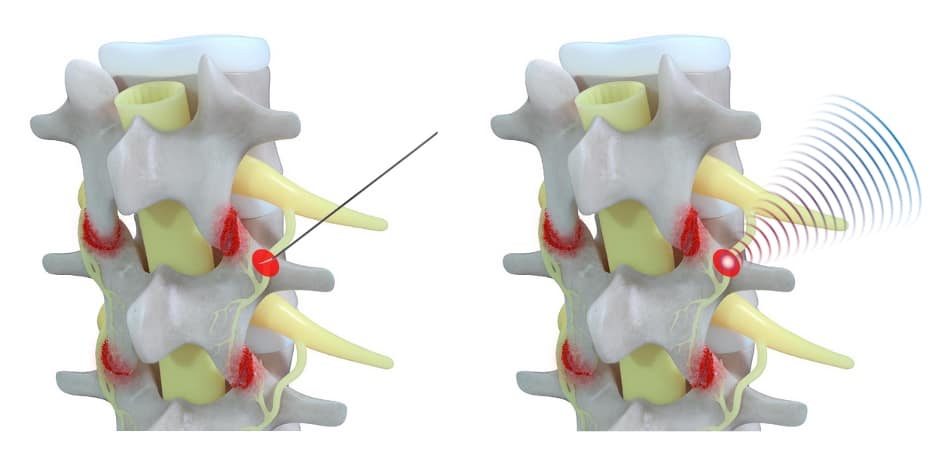
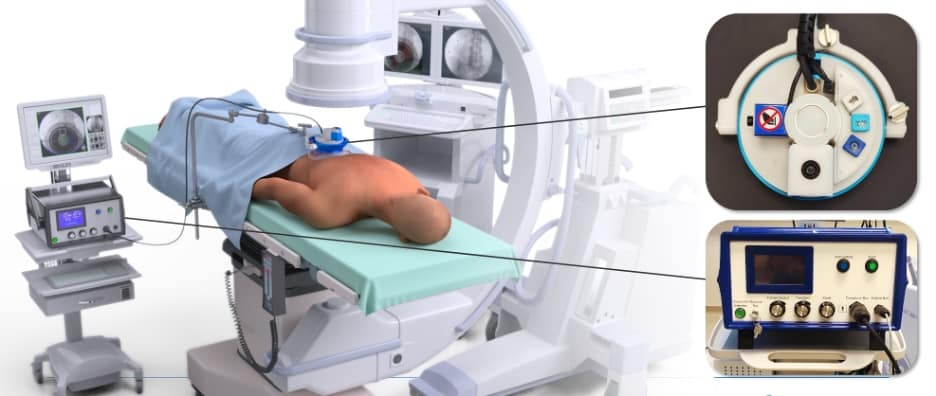
Based on current research, it is reasonable to consider HIFU for the treatment of chronic musculoskeletal pain for patients who have not experienced relief using conservative measures and are not surgical candidates.
While clinicians may more commonly treat musculoskeletal complaints with HIFU, it may also be used for cancer pain and painful bony metastasis. There are currently a large number of multicenter clinical studies investigating the use of HIFU for painful bony metastasis. It is believed that the effects of HIFU may come from both physical debulking of the tumor and thermal denervation of the bone and periosteum.1 Hurwitz et al. in their phase III clinical trial found MRgFUS to be superior to placebo initially after the procedure and at 3-month follow-up for those with painful bone metastasis.13
Adverse events are minimal. Current studies suggest that mild adverse effects likely decrease with the improvement of technician training. Common complications include skin burns and localized increased pain.14
Conclusion
While focused ultrasound use has grown exponentially in other medical fields, it is starting to gain significant traction in the world of pain medicine. Unfortunately, HIFU treatment is currently limited due to a lack of randomized controlled trial research, additional training for clinicians, and the need for specialized equipment. It is promising that clinicians can now produce ablation therapy via a small, precisely targeted, well-circumscribed lesion. The therapy is non-invasive, has no risk of radiotoxicity, and does not require needles, incisions, or sedation.



References
- Brown MRD, Farquhar-Smith P, Williams JE, et al. The use of high-intensity focused ultrasound as a novel treatment for painful conditions-a description and narrative review of the literature. Br J Anaesth2015;115(4):520-30. https://doi.org/10.1093/bja/aev302
- O’Brien WD, Dunn F. An early history of high-intensity focused ultrasound. Physics Today 2015; 68 (10):40-5. https://doi.org/10.1063/PT.3.2947
- Yang R, Reilly CR, Rescorla FJ, et al. Effects of high-intensity focused ultrasound in the treatment of experimental neuroblastoma. J Pediatr Surg 1992;27(2):246-50; discussion 250-1. https://doi.org/10.1016/0022-3468(92)90321-w
- Miller DL, Smith NB, Bailey MR, et al. Overview of therapeutic ultrasound applications and safety considerations. J Ultrasound Med 2012;31(4):623-34. https://doi.org/10.7863/jum.2012.31.4.623
- Davies EJ, Bazerbashi S, Asopa S, et al. Long-term outcomes following high intensity focused ultrasound ablation for atrial fibrillation. J Card Surg 2014;29(1):101-7. https://doi.org/10.1111/jocs.12234
- Namba H, Kawasaki M, Izumi M, et al. Effects of MRgFUS treatment on musculoskeletal pain: comparison between bone metastasis and chronic knee/lumbar osteoarthritis. Pain Res Manag 2019;2019:4867904. https://doi.org/10.1155/2019/4867904
- Kim H, Lee SD, Chiu A, et al. Estimation of the spatial profile of neuromodulation and the temporal latency in motor responses induced by focused ultrasound brain stimulation. Neuroreport 2014;25(7):475-9. https://doi.org/10.1097/WNR.0000000000000118
- Izumi M, Ikeuchi M, Kawasaki M, et al. MR-guided focused ultrasound for the novel and innovative management of osteoarthritic knee pain. BMC Musculoskelet Disord 2013;14:267. https://doi.org/10.1186/1471-2474-14-267
- Weeks EM, Platt MW, Gedroyc W. MRI-guided focused ultrasound (MRgFUS) to treat facet joint osteoarthritis low back pain--case series of an innovative new technique. Eur Radiol 2012;22(12):2822-35. https://doi.org/10.1007/s00330-012-2628-6
- Mahapatra S, Francois H, Weber-Levine C, et al. Focused ultrasound for the treatment of facet joint pain: a systematic review. Neurosurg Focus 2024;57(3):E9. https://doi.org/10.3171/2024.6.FOCUS24249
- Persson J, Strömqvist B, Zanoli G, et al. Ultrasound nucleolysis: an in vitro study. Ultrasound Med Biol2002;28(9):1189-97. https://doi.org/10.1016/s0301-5629(02)00566-5
- Kaye EA, Maybody M, Monette S, et al. Ablation of the sacroiliac joint using MR-guided high intensity focused ultrasound: a preliminary experiment in a swine model. J Ther Ultrasound 2017;5:17. https://doi.org/10.1186/s40349-017-0095-x
- Hurwitz MD, Ghanouni P, Kanaev SV, et al. Magnetic resonance-guided focused ultrasound for patients with painful bone metastases: phase III trial results. J Natl Cancer Inst 2014;106(5). https://doi.org/10.1093/jnci/dju082
- Yeo SY, Bratke G, Grüll H. High intensity focused ultrasound for treatment of bone malignancies-20 years of history. Cancers (Basel) 2022;15(1). https://doi.org/10.3390/cancers15010108