ASRA Pain Medicine Answers: Timeouts Before Regional Anesthesia Procedures—What Are the Minimum Requirements?
Cite as: Lim M, Deeble C, Boublik J, et al. ASRA answers: timeouts before regional anesthesia procedures—what are the minimum requirements?. ASRA Pain Medicine News 2025;50. https://doi.org/10.52211/asra080125.013.
ASRA Pain Medicine Answers
Introduction
Wrong-sided invasive procedures are considered “never events” in clinical practice because they are typically unambiguous, largely preventable, and pose a significant risk of harm. The Joint Commission defines these as “sentinel events,” which are described as “patient safety events that reach a patient and result in death, permanent harm (regardless of severity), or severe harm (regardless of duration), and are not primarily related to the natural course of illness or underlying condition.” While regional anesthesia procedures generally carry a low incidence of complications, the potential for short- and long-term adverse outcomes remains significant with a prospect of substantial morbidity. Consequently, performing a wrong-sided nerve block (WSNB), an invasive procedure, qualifies as both a “never event” and a reportable “sentinel event.” To further expand on this concept, we should never be performing "unintended blocks,” ie, performing a block on the wrong side, a wrong patient (those with contraindications, unknown consent status, etc.), or a wrong block (ie, a site-incongruent block).
Strategies to mitigate this risk and ensure patient safety include a strict adherence to a structured timeout protocol prior to regional anesthesia. Although rare, reports of WSNB range from 0.52 to 5.07 per 10,000 blocks, with contributing factors including time pressure, lack of site marking visibility, and communication breakdown.1 The bare minimum requirements of a time-out specific to regional anesthesia procedures remain variably defined. Our article highlights the importance of completing a pre-procedural checklist and timeout. Here, we aim to clarify essential elements of a timeout for regional anesthesia based on current literature and best practice recommendations.
Literature Review
Multiple professional societies and safety initiatives emphasize the importance of a formalized timeout,2-4 inspired by the Joint Commission’s Universal Protocol, which was initially created to prevent wrong-site, wrong-procedure, and wrong-person surgery.5 Application of the Universal Protocol is now mandatory for all invasive procedures, including regional anesthesia, to prevent sentinel “never events” such as WSNB. The importance of the time-out process, in addition to a preprocedural checklist and operative site marking, is reflected in the World Health Organization’s Surgical Safety Checklist, which has been shown to reduce morbidity and mortality.6 However, variability in how timeouts are structured and performed remains present, allowing institutions to tailor protocols based on workflow.
The concept of a timeout is concisely summarized and logically outlined in the United Kingdom’s “Stop before you block” campaign, which received wide recognition in clinical practice.4,7 The updated version, “Prep, STOP, block,” deconstructs the act of performing a block into three distinct phases: preparation, the stop moment, and the local anesthetic injection. This campaign emphasizes the creation of standardized operating procedures and practices across hospitals to prevent WSNB and analyze future events against a common framework.8
The timeout for regional anesthesia should be the final check of multiple redundant checks immediately performed prior to the regional procedure.9 The use of a preprocedural checklist before the timeout has been shown to decrease WSNB and enhance patient safety.10 Based on expert feedback, the ASRA Pain Medicine created a regional block preprocedural checklist, which includes patient identification based on two separate criteria, review of allergies and anticoagulation, confirmed consent, block plan and site marking, equipment availability, monitor application, aseptic technique, and the timeout.3 Similarly, checklists specific to pediatric regional anesthesia and a busy regional service at a military institution have been published.11,12 However, evidence regarding which checklist elements are universally indispensable remains sparse. Collectively, all guidelines emphasize provider-focused participation during the time-out process to mitigate patient safety risks.
The importance of the time-out process, in addition to a preprocedural checklist and operative site marking, is reflected in the World Health Organization’s Surgical Safety Checklist, which has been shown to reduce morbidity and mortality.
ASRA Answers
Performing timeouts before regional anesthesia procedures is not universal but needs widespread adoption for the sake of patient safety. The checklist is a broader preparatory tool, while the timeout serves as a final safety pause to confirm key details immediately before the procedure begins.
The Preprocedural Checklist
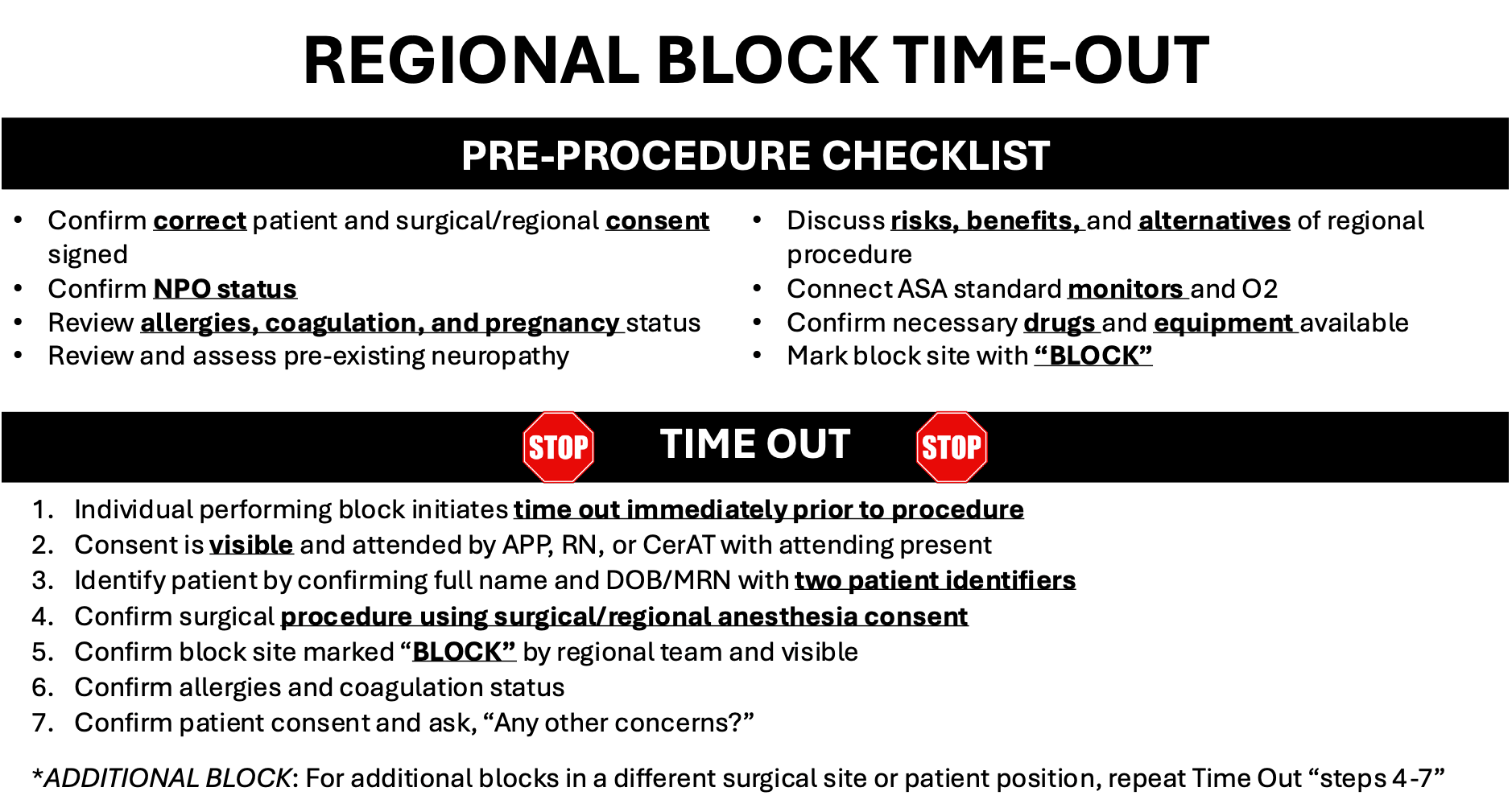
There is currently no single universally accepted checklist for regional anesthesia time-outs. Institutions adapt different checklist criteria according to specific needs, but omission of core components may compromise safety. It is recommended that a preprocedural checklist be performed prior to the timeout according to the three core principles of the Universal Protocol, which are pre-procedure verification, site marking, and timeout performance.5
The preprocedural checklist may vary according to institutional practices, but recommended criteria include identifying correct laterality of the block, verifying NPO status, evaluating anticoagulation status, and cross-checking relevant labs (white blood cells, platelets, coagulation profile), ensuring appropriate block equipment including resuscitation medications like Intralipid 20% is available, placing standard ASA monitors on the patient, and evaluating for baseline neuropathy or motor deficits. Other optional criteria that can be tailored to the patient and service include confirming local anesthetic dose and concentration, especially for patients with low ideal body weights, and evaluating the risks and benefits of a block, especially if there are concerns about infection or respiratory depression (specifically for brachial plexus blocks).
The Timeout
Based on current evidence and best practices, to enhance the safety and consistency of regional anesthesia timeouts, the bare minimum standards should include:
- Timeout is performed immediately prior to any regional procedure and repeated if necessary (ie, communication delays, change in patient positioning)9
- All stop for providers and active focused participation13
- Verifying the correct patient with two patient identifiers, block plan, and block site, including nerve block site marking
- Confirming patient allergies and coagulation status
- Confirming patient consent
Here are a few tips to improve the success of timeouts:
- Clinicians are encouraged to confirm patient identification with at least two identifiers, such as the patient’s full name, date of birth, or medical record number.
- The block site should be visibly marked by a provider with a skin marker on the regional service and cross-checked with the surgical consent.
- The type and laterality of the block must correlate with the region of intended surgical intervention.
- The patient’s understanding of the risks, benefits, and alternatives to a nerve block should be confirmed.
- Providers are advised to review patient allergies with special consideration for any allergies to equipment or local anesthetics traditionally used for regional blocks.
- It is recommended that posters containing all relevant time-out information be advertised in all areas where blocks are performed (Figure 1).4
- All team members participating in the timeout should have received education on the protocol and feel empowered to speak up to promote a culture of safety.14
- Ideally, a non-team member—someone not directly involved in the block procedure—should be designated to document or assist with the timeout. This practice reinforces protocol adherence and serves as an important gatekeeping measure.
Conclusions and Recommendations
A structured, formal timeout before regional anesthesia is a critical safety step that can prevent WSNB, allergic reactions, and procedural delays.13,15 Institutions are encouraged to develop standardized protocols, educate and train staff on their use, and periodically audit compliance to reinforce best practices and reduce errors and complications.




References
- Deutsch ES, Yonash RA, Martin DE, et al. Wrong-site nerve blocks: A systematic literature review to guide principles for prevention. J Clin Anesth 2018;46:101-11. https://doi.org/10.1016/j.jclinane.2017.12.008
- Blomberg A, Loskove J, Howard C, et al. A novel approach to eliminating wrong-site blocks. Anesthesia Patient Safety Foundation. https://www.apsf.org/article/a-novel-approach-to-eliminating-wrong-site-blocks. Published October 2021. Accessed December 16, 2024.
- Mulroy MF, Weller RS, Liguori GA. A checklist for performing regional nerve blocks. Reg Anesth Pain Med2014;39(3):195-9. https://doi.org/10.1097/AAP.0000000000000075. Erratum in: Reg Anesth Pain Med2014;39(4):357.
- French J, Bedforth N, Townsley P. Stop before you block campaign: supporting information. Royal College of Anaesthetists. https://www.rcoa.ac.uk/sites/default/files/documents/2020-08/SBYB-Supporting-Info.pdf. Published 2020. Accessed April 19, 2025.
- The universal protocol for preventing wrong site, wrong procedure, and wrong person surgery. The Joint Commission. https://www.jointcommission.org/-/media/tjc/documents/standards/universal-protocol/up_poster1pdf.pdf. Published July 2004. Accessed April 19, 2025.
- WHO surgical safety checklist implementation. World Health Organization. https://www.who.int/teams/integrated-health-services/patient-safety/research/safe-surgery/tool-and-resources. Published 2008. Accessed April 19, 2025.
- Topor B, Oldman M, Nicholls B. Best practices for safety and quality in peripheral regional anaesthesia. BJA Educ 2020;20(10):341-7. https://doi.org/10.1016/j.bjae.2020.04.007
- Haslam N, Bedforth N, Pandit JJ. 'Prep, stop, block': refreshing 'stop before you block' with new national guidance. Anaesthesia 2022;77(4):372-5. https://doi.org/10.1111/anae.15647
- Barrington MJ, Uda Y, Pattullo SJ, et al. Wrong-site regional anesthesia: review and recommendations for prevention? Curr Opin Anaesthesiol 2015;28(6):670-84. https://doi.org/10.1097/ACO.0000000000000258
- Henshaw DS, Turner JD, Dobson SW, et al. Preprocedural checklist for regional anesthesia: impact on the incidence of wrong site nerve blockade (an 8-year perspective). Reg Anesth Pain Med 2019;rapm-2018-000033. https://doi.org/10.1136/rapm-2018-000033
- Clebone A, Burian BK, Polaner DM. A time-out checklist for pediatric regional anesthetics. Reg Anesth Pain Med 2017;42(1):105-8. https://doi.org/10.1097/AAP.0000000000000509
- Mancone AG, Dickey AR, Fitzgerald BM, et al. LAST double check - a comprehensive pre-regional checklist for the busy institution. Mil Med 2018;183(9-10):e281-e5. https://doi.org/10.1093/milmed/usx220
- Harris SN, Ortolan SC, Edmonds CR, et al. Fewer wrong-site peripheral nerve blocks following updates to anesthesia time-out policy. HSS J 2021;17(2):180-4. https://doi.org/10.1177/1556331621993079
- Kwofie K, Uppal V. Wrong-site nerve blocks: evidence-review and prevention strategies. Curr Opin Anaesthesiol2020;33(5):698-703. https://doi.org/10.1097/ACO.0000000000000912
- Ha J. Preventing wrong-sided blocks. Int Anesthesiol Clin 2024;62(2):53-7. https://doi.org/10.1097/AIA.0000000000000436