Rebound Pain Following Peripheral Nerve Block: Emerging Insights and Future Directions
Cite as: Hodgetts JM, Ting Han Jen T, Uppal V. Rebound pain following peripheral nerve block: emerging insights and future directions. ASRA Pain Medicine News 2026;51. https://doi.org/10.52211/asra110126.015.
Rebound pain has been described as a specific form of severe, acute postoperative pain following nerve block resolution.1 Leading societies recently identified this phenomenon as one of the top priorities in regional anesthesia research.2 This intense pain experience often undermines the advantages of peripheral nerve blockade and may lead to increased patient dissatisfaction and even emergency readmission.3,4 However, is rebound pain a distinct phenomenon, or is it simply the expected emergence of pain when neural blockade wears off, particularly when multimodal analgesia has been inadequate? This article discusses emerging insights from recent evidence on rebound pain and explores potential future research directions.
Association of Peripheral Nerve Blockade with Increased Opioid Use — Cautious Interpretation Required
In 2025, an observational study was published in the British Journal of Anaesthesia exploring the association between peripheral nerve blockade (PNB) and increased postoperative pain and opioid use in patients undergoing orthopedic surgeries.5 The study’s accompanying editorial and seven letters to the editor demonstrate the importance and the controversies surrounding this study, as well as its limitations.6,7
This single-center retrospective cohort study included 22,956 patients undergoing orthopedic surgeries with general anesthesia.5 The authors used propensity score weighting to address confounding and complete-case analysis for missing data. They found that although single-injection PNBs improved pain scores and reduced opioid use in the post-anesthesia care unit, they were associated with a 23% increase in overall in-hospital opioid use and an increase in opioid prescriptions at 30 days after discharge. The authors postulated that these may be secondary to the downstream effects of rebound pain; however, we believe that a more cautious interpretation may be warranted.
The study has several important limitations. First, clinicians may preferentially offer PNB to patients expected to experience greater postoperative pain, and propensity score weighting using routinely collected electronic health record data cannot fully address this confounding by indication.6 Second, the outcome models were adjusted for variables that occurred after PNB administration, which may introduce bias. Third, the study did not directly measure rebound pain or formally evaluate it as a mediator.
While hypothesis-generating, the study’s limitations preclude causal inference; it should be read as a signal worth investigating rather than evidence that PNB increases opioid consumption through the rebound pain phenomenon.
Definition, Terminology, and Pathogenesis—The Need for Consensus
There is currently no consensus on the precise definition of rebound pain.1,8 Existing definitions in literature include the peak pain score within a certain timeframe (eg, 24 hours); an increase in pain score above a certain postoperative baseline; or pain exceeding a certain threshold (eg, numeric rating scale pain score of 7 or above) after block resolution.8 A related issue is that the terminology “rebound pain” is also controversial, and some prefer to use alternative terminologies such as “pain as regional anesthesia wears off” or simply “peak pain.”9 The imprecise definitions and terminologies create practical issues both in study design (ie, difficulty in outcome selection) and in systematic review and meta-analysis (ie, either inappropriate pooling or inappropriate exclusion).
These controversies stem from uncertainty about the pathophysiology of rebound pain — whether it reflects the unmasking of an expected nociceptive1 response or a true state of hyperalgesia after block administration.10 Results from preclinical studies in mice and rats suggest that local anesthetic administration may induce mechanical hypersensitivity or thermal hyperalgesia after block resolution.11-13 Nevertheless, these concerns were not replicated in humans. In 2026, Chen et al. published a randomized, within-subject controlled study of 40 healthy volunteers examining whether axillary brachial plexus block induced hypersensitivity.14 They found the opposite: The previously blocked arm showed less sensitization than the unblocked control arm, providing no evidence of post-PNB hyperalgesia and favoring the unmasking of nociceptive response as the primary mechanism for rebound pain.
Leading regional anesthesiology societies should collaborate to establish a consensus on the nomenclature and definition of rebound pain to ensure appropriate alignment in future research on this important topic.

The Promise of a Personalized Approach to Rebound Pain—Are We There Yet?
Experts recommend a personalized approach to postoperative acute pain management that incorporates patient, surgical, and institutional factors.15 Known risk factors for rebound pain include younger age, female sex, bony surgery, lack of dexamethasone use, preoperative pain, pain catastrophizing, and anxiety.16-18 Studies show that continuous blockade, compared with single-injection blockade, reduces the severity and incidence of rebound pain, likely because it better matches analgesic duration to the expected surgical pain trajectory.19-21 However, continuous blockade is a limited resource with increased cost, complexity, and risks. In theory, by considering the risk factors, maximal utility may be achieved by offering continuous blockade to those at the highest risk of severe rebound pain.
Unfortunately, to date, the promise of an individualized approach to addressing rebound pain has not been realized due to difficulty predicting rebound pain risk at the individual level.22 A risk prediction model built with routinely collected clinical predictors (eg, age, sex, surgery type, planned admission, local anesthetic type, no perioperative dexamethasone use, and intraoperative anesthesia type) had poor predictive performance. Predictors that are not routinely collected, such as pain catastrophizing, anxiety, gut microbiome composition, genetics, and others, may play an important role in predicting severe rebound pain occurrence.17,18,23 Nevertheless, incorporated predictors must also be readily obtainable in clinical practice to ensure the model’s practical applicability.
Current Evidence for Possible Rebound Pain Prevention Strategies
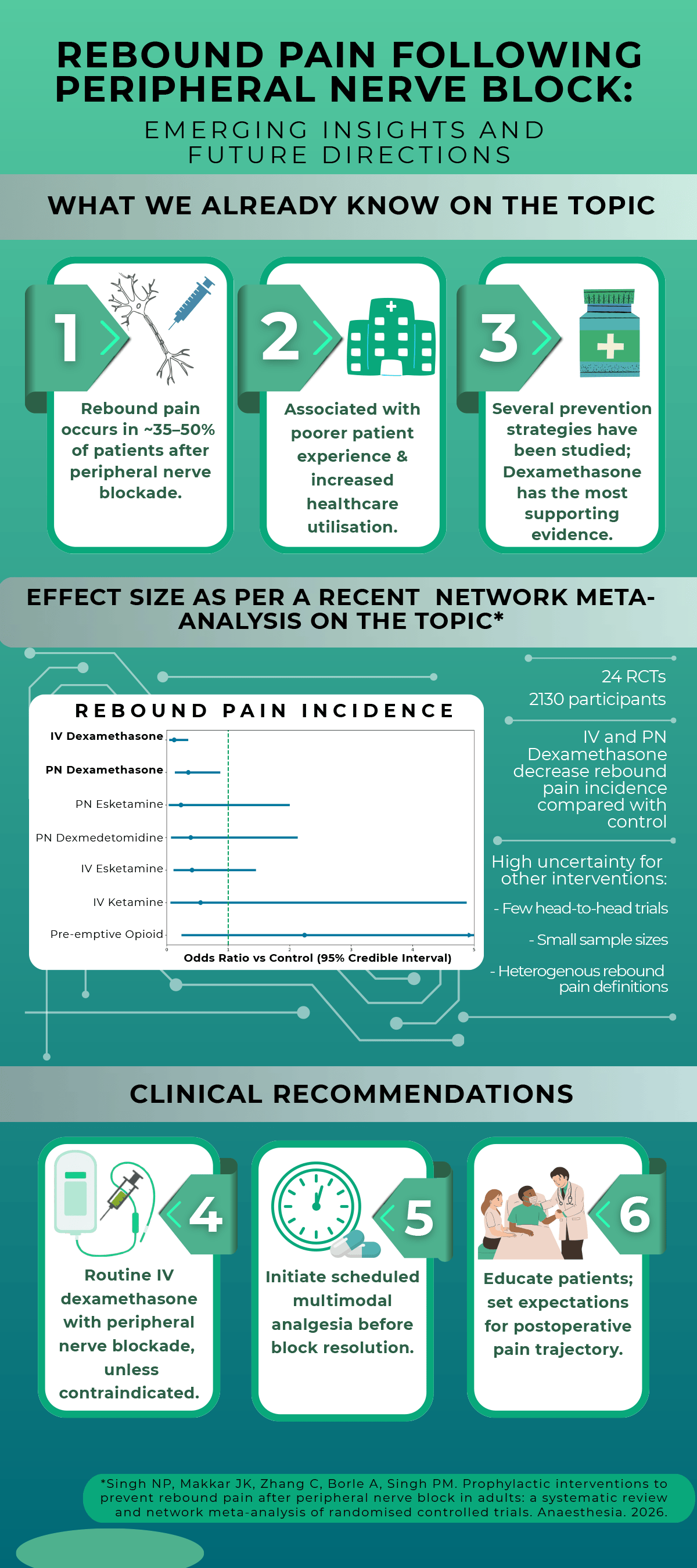
In May 2026, a systematic review and network meta-analysis of randomized controlled trials was published on prophylactic interventions to prevent rebound pain.24 Consistent with previous systematic reviews,25,26 intravenous and perineural dexamethasone were found to decrease rebound pain incidence compared with control. However, uncertainty remained high regarding the efficacy of other interventions because of small sample sizes, few head-to-head trials, and heterogeneous outcome definitions (Figure 1).8 As such, conclusions cannot be appropriately drawn on the relative efficacy of each intervention.
Future Directions
Rebound pain remains a clinically important problem in regional anesthesia. The recent evidence reframes how we should think about it: Rather than a unique harm caused by PNB, rebound pain is best understood as the expected return of surgical pain once a block resolves without adequate analgesic bridging. Progress now depends on three priorities: (1) establishing a consensus definition and nomenclature so that future trials can be meaningfully compared when pooling the data, (2) identifying predictors beyond routinely collected variables and incorporating them into risk prediction model updates, and (3) generating high-quality, adequately powered trials for promising interventions. The current most defensible strategy is a standardized institutional pathway with routine intravenous dexamethasone, scheduled multimodal analgesia timed to precede block resolution, and patient education that sets realistic expectations. With these foundations, peripheral nerve blocks can continue to deliver their substantial benefits while their principal drawback is anticipated and managed rather than feared.



References
- Muñoz-Leyva F, Cubillos J, Chin KJ. Managing rebound pain after regional anesthesia. Korean J Anesthesiol 2020;73:372-83. https://doi.org/10.4097/kja.20436
- Ferry J, Lewis O, Lloyd J, et al. Research priorities in regional anaesthesia: an international Delphi study. Br J Anaesth 2024;132:1041-8. https://doi.org/10.1016/j.bja.2024.01.033
- Hade AD, Okano S, Pelecanos A, et al. Factors associated with low levels of patient satisfaction following peripheral nerve block. Anaesth Intensive Care 2021;49:125-32. https://doi.org/10.1177/0310057X20972404
- Sunderland S, Yarnold CH, Head SJ, et al. Regional versus general anesthesia and the incidence of unplanned health care resource utilization for postoperative pain after wrist fracture surgery: results from a retrospective quality improvement project. Reg Anesth Pain Med 2016;41:22-7. https://doi.org/10.1097/AAP.0000000000000325
- Chung AR, Mather RV, Gutierrez R, et al. Association of peripheral nerve blocks with increased postoperative pain and opioid use in orthopaedic surgery: a single-centre retrospective cohort study. Br J Anaesth 2025;135:1286-96. https://doi.org/10.1016/j.bja.2025.05.030
- Wu CL, Badani S, Tedore TR. Peripheral nerve blocks for perioperative analgesia: das Kind mit dem Bade ausschütten…throwing the baby out with the bathwater? Br J Anaesth 2025;135:1147-50. https://doi.org/10.1016/j.bja.2025.08.017
- Sonawane K. Association of peripheral nerve blocks with increased postoperative pain and opioid use in orthopaedic surgery: importance of multimodal analgesia. Comment on Br J Anaesth 2025; 135:1286-96. Br J Anaesth 2026;136:1642-4. https://doi.org/10.1016/j.bja.2026.01.034
- Jen TTH, Uppal V. The quest to prevent rebound pain: clarity or uncertainty? Anaesthesia 2026;81:1205-8. https://doi.org/10.1111/anae.70242
- Singla P, Ye Y, Elkassabany NM, et al. ‘Pain as regional anaesthesia wears off’ or ‘rebound pain’: what’s in a name? Anaesthesia 2025;80:607-11. https://doi.org/10.1111/anae.16583
- Dada O, Gonzalez Zacarias A, Ongaigui C, et al. Does rebound pain after peripheral nerve block for orthopedic surgery impact postoperative analgesia and opioid consumption? A narrative review. Int J Environ Res Public Health 2019;16:3257. https://doi.org/10.3390/ijerph16183257
- Puljak L, Kojundzic SL, Hogan QH, et al. Lidocaine injection into the rat dorsal root ganglion causes neuroinflammation. Anesth Analg 2009;108:1021-6. https://doi.org/10.1213/ane.0b013e318193873e
- E Q, Wu Y, Liang X, et al. Establishment of an animal model of sciatic nerve injury induced by local anesthetics. Hum Exp Toxicol 2023;42:9603271231173382. https://doi.org/10.1177/09603271231173382
- Kolarczyk LM, Williams BA. Transient heat hyperalgesia during resolution of ropivacaine sciatic nerve block in the rat. Reg Anesth Pain Med 2011;36:220-4. https://doi.org/10.1097/AAP.0b013e3182176f5a
- Chen YK, Wilson JM, Collins PW, et al. Evaluation of postblock hypersensitivity using quantitative sensory testing before, during, and after axillary brachial plexus block resolution in healthy volunteers. Anesthesiology 2026;145:322-32. https://doi.org/10.1097/ALN.0000000000006082
- Chitnis SS, Tang R, Mariano ER. The role of regional analgesia in personalized postoperative pain management. Korean J Anesthesiol 2020;73:363-71. https://doi.org/10.4097/kja.20323
- Barry GS, Bailey JG, Sardinha J, et al. Factors associated with rebound pain after peripheral nerve block for ambulatory surgery. Br J Anaesth 2021;126:862-71. https://doi.org/10.1016/j.bja.2020.10.035
- Touil N, Pavlopoulou A, Barbier O, et al. Factors associated with a reduction in the preventive effect of intravenous dexamethasone on rebound pain after axillary brachial plexus block. Br J Anaesth 2025;135:1059-66. https://doi.org/10.1016/j.bja.2025.05.055
- Touil N, Pavlopoulou A, Barbier O, et al. Evaluation of intraoperative ketamine on the prevention of severe rebound pain upon cessation of peripheral nerve block: a prospective randomised, double-blind, placebo-controlled study. Br J Anaesth 2022;128:734-41. https://doi.org/10.1016/j.bja.2021.11.043
- Williams BA, Bottegal MT, Kentor ML, et al. Rebound pain scores as a function of femoral nerve block duration after anterior cruciate ligament reconstruction: retrospective analysis of a prospective, randomized clinical trial. Reg Anesth Pain Med 2007;32:186-92. https://doi.org/10.1016/j.rapm.2006.10.011
- Ding DY, Manoli A, Galos DK, et al. Continuous popliteal sciatic nerve block versus single injection nerve block for ankle fracture surgery: a prospective randomized comparative trial. J Orthop Trauma 2015;29:393-8. https://doi.org/10.1097/BOT.0000000000000374
- Ganta A, Ding D, Fisher N, et al. Continuous infraclavicular brachial block versus single-shot nerve block for distal radius surgery: a prospective randomized control trial. J Orthop Trauma 2018;32:22-6. https://doi.org/10.1097/BOT.0000000000001021
- Jen TTH, Ke JXC, Wing KJ, et al. Development and internal validation of a multivariable risk prediction model for severe rebound pain after foot and ankle surgery involving single-shot popliteal sciatic nerve block. Br J Anaesth 2022;129:127-35. https://doi.org/10.1016/j.bja.2022.03.030
- Brenner D, Cherry P, Switzer T, et al. Pain after upper limb surgery under peripheral nerve block is associated with gut microbiome composition and diversity. Neurobiol Pain 2021;10:100072. https://doi.org/10.1016/j.ynpai.2021.100072
- Singh NP, Makkar JK, Zhang C, et al. Prophylactic interventions to prevent rebound pain after peripheral nerve block in adults: a systematic review and network meta-analysis of randomised controlled trials. Anaesthesia 2026;81:1281-92. https://doi.org/10.1111/anae.70236
- Singh NP, Makkar JK, Chawla JK, et al. Prophylactic dexamethasone for rebound pain after peripheral nerve block in adult surgical patients: systematic review, meta-analysis, and trial sequential analysis of randomised controlled trials. Br J Anaesth 2024;132:1112-21. https://doi.org/10.1016/j.bja.2023.09.022
- Makkar JK, Singh NP, Khurana BJK, et al. Efficacy of different routes of dexamethasone administration for preventing rebound pain following peripheral nerve blocks in adult surgical patients: a systematic review and network meta-analysis. Anaesthesia 2025;80:704-12. https://doi.org/10.1111/anae.16566