Artificial Intelligence: Is the Best Way Out of Our Environmental Crisis to Dig Deeper Into It?
Cite as: Corbitt R, Schroeder KM. Artificial intelligence: is the best way out of our environmental crisis to dig deeper into it. ASRA Pain Medicine News 2025;50. https://doi.org/10.52211/asra050125.011.
Presumption
Imagining a future in which artificial intelligence (AI) completely replaces our profession is a terrifying thought experiment if you hope to have a long-lasting (hands-on) career in anesthesia. Though we’d like to believe we will always place an epidural or perform a supraclavicular block better than any deep learning-equipped robot ever could, there's no denying the explosive growth of the AI industry in recent years.
The Atmospheric View
While enthusiastic investors pin long-run economic hopes (and short-run market returns) on AI-powered efficiencies, others are concerned about potential doomsday AI scenarios portrayed in pop culture. Regardless of one’s views, AI continues to integrate itself into various areas far beyond persuasive deepfakes on social media. Healthcare, the energy sector, education, and other spheres have all reached into the AI black box. In regional anesthesia, AI-enabled technology can analyze ultrasound images to label pertinent nerve block anatomy and enhance needle tracking.1 Epidural needles equipped with pressure sensors at their orifice can distinguish different tissue types and alert the proceduralist to loss of resistance.2 Handheld ultrasound devices with image recognition technology can assist with locating the correct needle puncture site and predict epidural depth for neuraxial anesthesia.3 These technologies are intended to make patient care more manageable and safer. Often overlooked in the hype is the substantial environmental impact of AI, which poses the question: How can we ensure the gains from AI outweigh the enormous upfront environmental expense? Put differently, as we dig ourselves further into an environmental hole to bring AI to life, can we envision a green path on the back end of this technology?
The Promise of AI
The era of artificial intelligence is upon us. By 2030, AI will provide an estimated 21% net increase in the United States gross domestic product with a trajectory pointing towards exponential growth of the overall value of the AI industry.4 The so-called “Magnificent Seven” technology stocks, driven to previously unreached highs by AI hopes, have risen to over a third of the total value of the S&P 500 as billions of investment dollars have flooded into the companies creating AI models and the businesses supplying them with crucial components.5 Optimists are excited about the potential for AI to advance environmental stewardship. AI can track changes in forest composition and iceberg movement via satellite data, scan and analyze crops to detect pests and prevent spoilage, map ocean pollution to better direct clean-up efforts, and identify waste that can be recycled.6 AI may accelerate research into materials and production methods that result in fewer greenhouse gas emissions, and it could use historical and incoming data to model outcomes of interventions aimed to reduce the carbon footprint. If anything, the constant eye of an indefatigable machine, trained on decades worth of climate datasets, could help us predict extreme weather events so that we can better respond to natural disasters.7 Applying AI to healthcare could reduce carbon footprint via the optimization of OR scheduling,8 the facilitation of telemedicine, improvement in the accuracy and speed of diagnostics to reduce unnecessary testing and resource utilization,9 and the use of autonomous AI to assist with point-of-care diagnostics to minimize transport-associated emissions.10 However, this promise can only be realized by paying hefty startup costs, both economic and environmental.
The electronics the data centers house, rely on a staggering number of resources: a 2 kg computer requires 800 kg of raw materials, including rare earth elements, such as tungsten, palladium, cobalt, and tantalum for microchips.
Negative Environmental Impact of AI
Even if artificial intelligence has not yet replaced humans in the labor market, it has established itself as a competitive coworker with efficiency and immunity to dangerous situations. Medicine has not been left untouched with radiologists seemingly having been in the crosshairs of AI enthusiasts since the first image recognition technology was introduced. The Federal Drug Administration has already approved over 950 AI and machine learning-enabled medical devices—the vast majority of algorithms being in radiology with cardiology coming in second, and anesthesiology representing only a handful for now. Privacy issues often come to the fore as AI is typically trained by scraping vast amounts of data from the internet, far in advance of formal rules governing who owns the content that AI is trained on, much less whether anyone should be compensated for it and how.
Not to go unnoticed is the impact on the environment that the rapid growth of AI threatens to cause. The United Nations has already warned about the adverse effects of the explosion of AI and its associated infrastructure on the environment.12 One way that AI is already affecting our environment is in the massive energy requirements related to the training and use of these platforms. The large language model GPT-3 used 1,287 megawatt hours to train, over 100 times the energy the average United States household uses in a year (Figure 1).13 Each query consumes ten times the electricity of a standard search engine.14 Energy use for image generation is even greater; to create one picture, some models require as much energy as it takes to charge an old smartphone.15 The surge of greenhouse gas emissions from data centers is already substantial, but AI energy needs continue to grow. The International Data Corporation expects AI data center energy consumption to grow at a CAGR of 44.7% through 2027.16 This energy hunger has the potential to overwhelm renewable energy efforts and force a retreat to traditional carbon-emitting energy pathways. The decline in coal-based electricity generation has slowed tremendously to keep up with the introduction of AI platforms, and there are concerns that the United States will be unable to achieve its goals of a carbon-pollution-free electricity sector that had been planned for 2035.17 This tremendous thirst for joules is threatening to derail efforts aimed at decarbonization and has recently prompted efforts by an information technology giant to restart the Three Mile Island nuclear reactor to respond to the demands of growing data centers.18
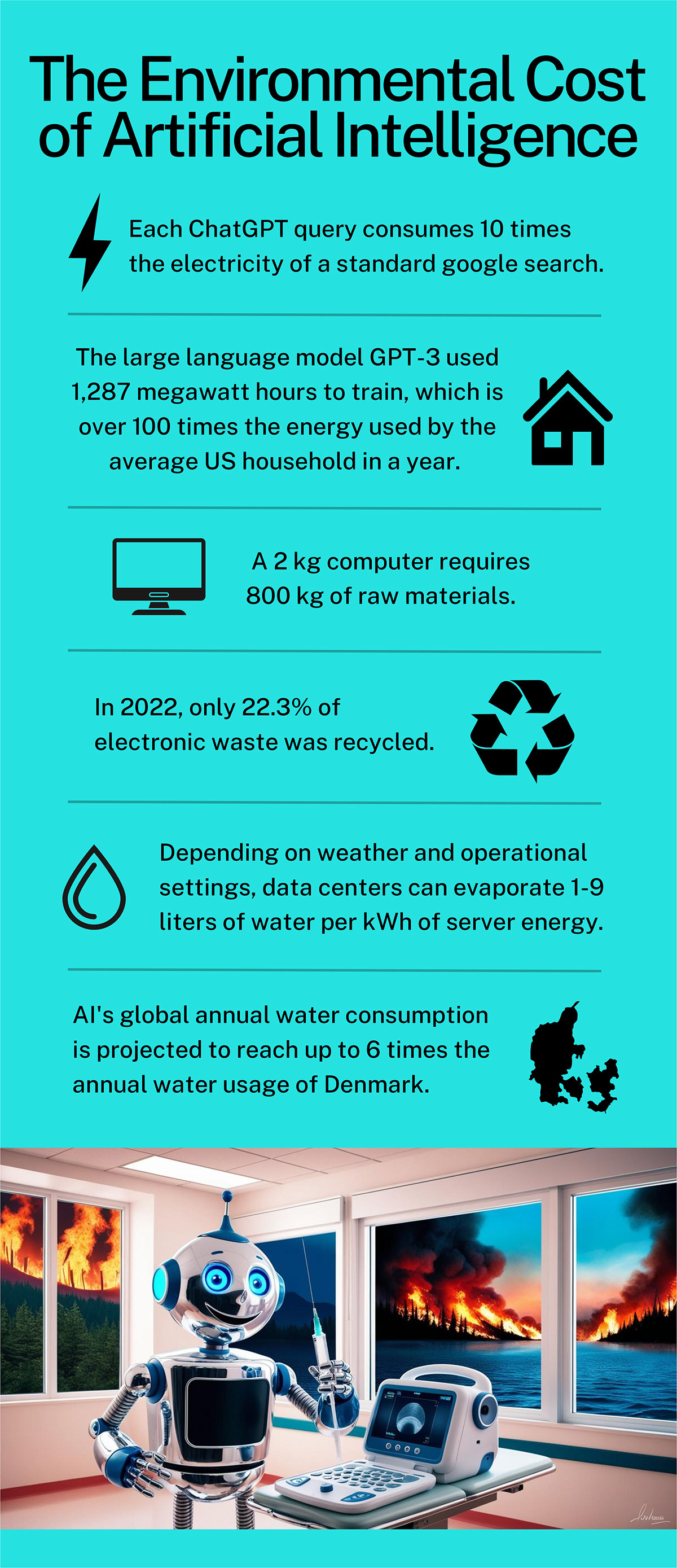
The electronics the data centers house, rely on a staggering number of resources: a 2 kg computer requires 800 kg of raw materials, including rare earth elements, such as tungsten, palladium, cobalt, and tantalum for microchips.19 Mining these resources contributes to greenhouse gas emissions, causes damage to the land, and leads to biodiversity loss. Recycling those computer chips at the end of their lifespans or any of our smart devices when we trade them out for newer models is incredibly complex and expensive. In 2022, only 22.3% of e-waste was recycled. Further harms to the ecological system are the materials from e-waste that leach hazardous toxins, such as flame retardants and lead, into the groundwater, soil, and air.20
In addition to being hungry for electricity and raw materials, AI is thirsty for water, which it needs to cool processors to avoid server overheating. Water demand for AI purposes is estimated to approach 6.6 billion cubic meters by 2027, a volume that is approximately half of the United Kingdom’s annual consumption or six times more than that of Denmark, a country of 6 million people.21 One issue unique to AI-based water consumption is that the water is consumed and lost to evaporation versus returned for treatment and potential re-utilization.22 Depending on weather and operational settings, data centers can evaporate 1-9 liters of water per kWh of server energy.21 These water concerns only compound worsening shortages experienced in much of the world. This also becomes an ethical problem when a quarter of humanity lacks access to clean water and sanitation.23
Given these enormous costs and the unstoppable juggernaut of AI development and expansion into every area of daily life, it becomes vital to utilize AI as efficiently as possible with a mind toward environmental impact. Strategies to mitigate the negative environmental effects of AI will include the development of energy-efficient AI models tailored for their specific tasks, optimization of data storage, integration of renewable energy sources (solar and wind power, and perhaps eventually nuclear fusion), responsible management of electronic waste, continuous monitoring of the impact of AI in healthcare, and promotion of a culture of sustainability.24
How Does this Affect Anesthesiologists?
AI could potentially improve how we deliver perioperative care. However, if the application of AI in healthcare exacerbates the climate crisis in some aspects, it is imperative that every user be cognizant of the negative environmental effect of AI and use it responsibly. The tremendous volume of data created during a standard anesthetic administration, conveniently charted in electronic records, could present an opportunity for AI to identify areas where we could elevate our practice from an environmental standpoint.
Potential considerations worthy of future investigation:
- Improvements in Intraoperative Efficiency
- Optimizing anesthetic delivery: AI could be used to minimize excess drug administration by evaluating patient age and comorbidities to personalize care, optimize dosages, and minimize waste. This may be particularly important in delivering inhaled anesthetic agents (desflurane and nitrous oxide) associated with a high global warming potential. This could also be applied to total intravenous anesthetic doses to more precisely time emergence to reduce delayed extubation, thus improving operating room efficiency.25
- Reducing operating room waste: Image recognition technology could assist with proper waste sorting by picking out recyclable materials from trash, separating contaminated from non-contaminated material, and reducing the amount of red bag waste, which is more expensive to dispose of and can release toxic byproducts from incineration.26 By analyzing waste volume, types, and disposal patterns, AI could help hospital administrators understand waste patterns and identify areas for improvement.
- Improvements in Practice Efficiency
- Increasing care per unit of time: AI could predict surgical duration and length of post-anesthesia care unit (PACU) stay, identify surgeries with a high risk of cancellation, determine which patients will need an ICU bed, create efficient operating room schedules, and allocate human resources appropriately.8
- Monitoring and reducing energy consumption: AI could monitor and manage energy consumption (eg, HVAC, lighting) in operating rooms, pre-op areas, and PACUs to determine where and when energy can be saved.27
- Evaluating equipment procurement, inventory, and maintenance: AI could analyze material procurement options to select products with the lowest environmental impact. AI could also manage inventory and purchasing to limit waste and storage space requirements.28
- Education
- Creating new learning environments: The use of AI and advancements in virtual reality may ultimately eliminate the need for dedicated simulation centers and represent an enhanced learning pathway that eliminates the space and equipment requirements associated with traditional medical learning environments for regional anesthesia and general anesthesia training.
- Providing personalized feedback: Through analysis of anesthetic records and recordings from intraoperative cameras, which are already infiltrating many ORs,29 AI could provide personalized feedback to anesthesia providers and suggest areas for improvement regarding procedural time, drug dosing, and workspace setup.30
Conclusion
The destructive environmental costs associated with developing and using artificial intelligence cannot be ignored. Still, there is potential for AI to also make healthcare delivery more efficient with an eye toward environmental stewardship. Research and discussions that advance the understanding of how to best implement AI into clinical practice are required and depend upon the dedication of interested clinicians. Though we are far away from the development of a system that would entirely replace the role of an anesthesiologist, artificial intelligence is rushing in like an oncoming storm. We could hunker down passively and hope to wait it out, but a better course would be to understand it and learn to use it to serve ourselves, our patients, and the world we inhabit.


References
- Bowness JS, Burckett-St Laurent D, Hernandez N, et al. Assistive artificial intelligence for ultrasound image interpretation in regional anaesthesia: an external validation study. Br J Anaesth 2023;130(2):217-25. https://doi.org/10.1016/j.bja.2022.06.031
- Vaira P, Camorcia M, Palladino T, et al. Differentiating false loss of resistance from true loss of resistance while performing the epidural block with the CompuFlo® epidural instrument. Anesthesiol Res Pract 2019;2019:5185901. https://doi.org/10.1155/2019/5185901
- Ni X, Li MZ, Zhou SQ, et al. Accuro ultrasound-based system with computer-aided image interpretation compared to traditional palpation technique for neuraxial anesthesia placement in obese parturients undergoing cesarean delivery: a randomized controlled trial. J Anesth 2021;35(4):475-82. https://doi.org/10.1007/s00540-021-02922-y
- Stratton B. 27 mind-blowing AI industry growth statistics in 2024 (and beyond). Blue Tree Digital. https://bluetree.digital/ai-industry-growth-metrics/#:~:text=AI%20is%20expected%20to%20contribute%20a%20significant%2021%25,companies%20are%20adopting%20AI%20because%20of%20labor%20shortages. Published October 11, 2024. Accessed November 20, 2024.
- Wendling J. Charted: magnificent 7 market cap as a share of the S&P 500. Visual Capitalist. https://www.visualcapitalist.com/sp/charted-magnificent-7-market-cap-as-a-share-of-the-sp-500/. Published December 11, 2024. Accessed February 7, 2025.
- Masterson V. 9 ways AI is helping tackle climate change. World Economic Forum. https://www.weforum.org/stories/2024/02/ai-combat-climate-change. Published February 12, 2024. Accessed November 21, 2024.
- Materia S, García LP, van Straaten C, et al. Artificial intelligence for climate prediction of extremes: state of the art, challenges, and future perspectives. WIREs Climate Change 2024;15(6). https://doi.org/10.1002/wcc.914
- Bellini V, Russo M, Domenichetti T, et al. Artificial intelligence in operating room management. JJ Med Syst 2024;48(1). https://doi.org/10.1007/s10916-024-02038-2
- Chaika M, Afat S, Wessling D, et al. Deep learning-based super-resolution gradient echo imaging of the pancreas: improvement of image quality and reduction of acquisition time. Diagn Interv Imaging 2023;104(2):53-9. https://doi.org/10.1016/j.diii.2022.06.006
- Wolf RM, Abramoff MD, Channa R, et al. Potential reduction in healthcare carbon footprint by autonomous artificial intelligence. NPJ Digit Med 2022;5(1). https://doi.org/10.1038/s41746-022-00605-w
- Artificial intelligence and machine learning (AI/ml)-enabled medical devices. U.S. Food and Drug Administration. https://www.fda.gov/medical-devices/software-medical-device-samd/artificial-intelligence-and-machine-learning-aiml-enabled-medical-devices. Published December 20, 2024. Accessed December 9, 2024.
- AI has an environmental problem. Here’s what the world can do about that. UN Environment Programme. https://www.unep.org/news-and-stories/story/ai-has-environmental-problem-heres-what-world-can-do-about. Published September 21, 2024. Accessed December 9, 2024.
- Lesiv A. How much energy will it take to power AI? Contrary. https://www.contrary.com/foundations-and-frontiers/ai-inference. Published July 11, 2024. Accessed January 6, 2025.
- De Vries A. The growing energy footprint of artificial intelligence. Joule 2023;7(10):2191-4. https://doi.org/10.1016/j.joule.2023.09.004
- Luccioni S, Jernite Y, Strubell E. Power hungry processing: watts driving the cost of AI deployment? The 2024 ACM Conference on Fairness, Accountability, and Transparency. 2024;85-99. https://doi.org/10.1145/3630106.3658542
- IDC. IDC report reveals AI-driven growth in datacenter energy consumption, predicts surge in datacenter facility spending amid rising electricity costs. IDC Research. https://www.idc.com/getdoc.jsp?containerId=prUS52611224. Published September 24, 2024. Accessed December 9, 2024.
- Chu A. US slows plans to retire coal plants as power demand from AI surges. Financial Times. https://archive.is/xpcVv#selection-1571.0-1571.67. Published May 30, 2024. Accessed December 2, 2024.
- Greshko M. Nuclear power for AI: what it will take to reopen Three Mile Island safely. Nature 2024;634(8033):272-3. https://doi.org/10.1038/d41586-024-03162-2
- United Nations Conference on Trade and Development. Conference on shaping an environmentally sustainable and inclusive digital future in Africa. https://unctad.org/meeting/conference-shaping-environmentally-sustainable-and-inclusive-digital-future-africa. Published September 4, 2024. Accessed Month Day, 2024.
- United Nations Institute for Training and Research. Electronic waste rising five times faster than documented e-waste recycling. The Global Waste Monitor. https://unitar.org/about/news-stories/press/global-e-waste-monitor-2024-electronic-waste-rising-five-times-faster-documented-e-waste-recycling. Published March 20, 2024. Accessed Month Day, 2024.
- Li P, Yang J, Islam MA, et al. Making AI less “thirsty”: uncovering and addressing the secret water footprint of AI models. ArXiv. https://arxiv.org/pdf/2304.03271. Published October 29, 2023. Accessed December 8, 2024.
- Rogers R. AI’s energy demands are out of control. Welcome to the internet’s hyper-consumption era. Wired. https://www.wired.com/story/ai-energy-demands-water-impact-internet-hyper-consumption-era. Published July 11, 2024. Accessed November 19, 2024.
- Water. United Nations: Peace, dignity and equality on a healthy planet. https://www.un.org/en/global-issues/water. Published January 8, 2021. Accessed January 1, 2025.
- Ueda D, Walston SL, Fujita S, et al. Climate change and artificial intelligence in healthcare: review and recommendations towards a sustainable future. Diagn Interv Imaging 2024;105(11):453-9. https://doi.org/10.1016/j.diii.2024.06.002
- Automated bliss: transforming anesthesia care through artificially intelligent drug delivery. Beyond the Mask. https://beyondthemaskpodcast.com/automated-bliss-transforming-anesthesia-care-through-artificially-intelligent-drug-delivery/4612. Published March 5, 2024. Accessed December 8, 2024.
- Hood R. Streamlining brachytherapy operating room waste management with artificial intelligence. UCSF Campus Life Services. https://campuslifeserviceshome.ucsf.edu/sustainability/news/streamlining-brachytherapy-operating-room-waste-management-artificial-0. Published July 18, 2023. Accessed December 9, 2024.
- Lee D, Chen L. Sustainable air-conditioning systems enabled by artificial intelligence: research status, enterprise patent analysis, and future prospects. Sustainability 2022;14(12). https://doi.org/10.3390/su14127514
- Negbi A. Transforming healthcare inventory management systems with AI. IDENTI Medical Data Sensing. https://identimedical.com/transforming-healthcare-inventory-management-with-ai. Published August 19, 2024. Accessed Month Day, 2024.
- Mole B. AI “black box” placed in more hospital operating rooms to improve safety. Ars Technica. https://arstechnica.com/health/2024/01/ai-powered-surveillance-of-hospital-operating-rooms-expands-in-boston. Published January 16, 2024. Accessed December 10, 2024.
- Laufer S. Harnessing the power of AI for medical simulators. Lecture presented at Grand Rounds. https://www.youtube.com/watch?v=mQeLgBWBNVc. Published November 14, 2023. Accessed December 10, 2024.