Making Waves: ASRA Pain Medicine 2026 Invites You to Tampa — and Beyond
Cite as: Doshi T, Nelson A. Making waves: ASRA Pain Medicine 2026 invites you to Tampa — and beyond. ASRA Pain Medicine News 2026;51. https://doi.org/10.52211/asra080126.003.
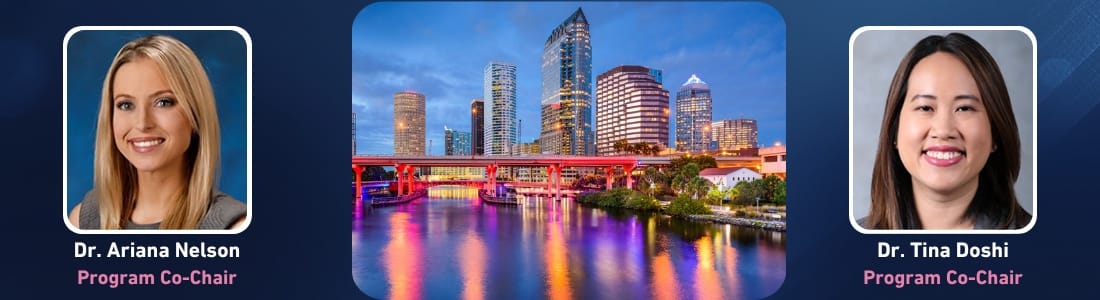
On behalf of the ASRA Pain Medicine 2026 Program Committee, we are thrilled to invite you to the 25th Annual Pain Medicine Meeting, November 5–7, 2026, in Tampa, FL, at the JW Marriott Tampa Water Street and Marriott Tampa Water Street.
As co-chairs, we genuinely cannot wait for this meeting, and if you’re familiar with ASRA Pain Medicine, you already know why. More than any single lecture, workshop, or networking event, what keeps so many of us coming back year after year is the community. The annual meeting feels less like a conference and more like a family reunion, a place where friends and colleagues reconnect, mentors and trainees reunite, and new members are welcomed into the ASRA Pain Medicine family.
What inspires us most about this society is its commitment to thoughtful dialogue. ASRA Pain Medicine is not here to blithely champion procedures or blindly dismiss them. We embrace innovation while asking hard questions, always striving to keep patients at the center of our work. Across specialties, disciplines, practice settings, and career stages, people come together here to engage in deep, respectful conversations about the challenges facing pain medicine. We do not agree on every issue, but some of our most meaningful discussions arise from differing perspectives. What unites us is not a single position, but a shared commitment to improving the lives of the patients we serve.
That spirit of curiosity, collaboration, and respectful debate inspired this year’s theme: Making Waves: Turning the Tide in Pain Medicine. Building on the momentum of recent years and in the spirit of Let’s Go and The Whole Clinic, this year’s meeting challenges us to envision and shape the future of our specialty in an era of rapid transformation. Making Waves is about people and ideas that create impact: pioneers, innovators, master educators, and advocates who push boundaries and turn scientific momentum into real-world change in pain practice.
The 25th Annual Pain Medicine Meeting delivers on that promise with a program that combines engaging new formats, reimagined favorites, and dedicated tracks for every member of the pain medicine team.
A Sea Change: ASRA Pain Medicine Debates
New this year is the ASRA Pain Medicine Debate series, featured in Saturday’s plenary session. These structured, head-to-head debates will bring together leading voices in our specialty to examine challenging and controversial questions in pain medicine.
The debates will explore three evolving topics:
- Particulate vs. Nonparticulate: What is safe in the transforaminal syringe? This is a timely debate given the soon-to-be published ASRA-sponsored guidelines on epidural steroid injections. Faculty will address the evidence, risk, and clinical judgment behind steroid selection for transforaminal epidural injections.
- Ablate vs. Regenerate: Will RFA/BVNA stay the course, or will regenerative therapies turn the tide? Hear competing perspectives on where these approaches stand today, and where the evidence may be headed, in the management of chronic pain.
- Artificial Intelligence vs. The Attending: Will AI algorithms increasingly steer healthcare, or will humans remain at the helm? Faculty will debate two competing futures for clinicians: one where care remains human-centered with AI as an augmenting tool, and another where care becomes technology-driven, with physicians shifting toward developing protocols and providing ethical oversight.
Expect sharp arguments, genuine disagreement, and the kind of productive friction that actually moves a field forward. Whether you stand firm or get pulled by the tide, either way you’ll emerge with new insights.
Making Waves on the Main Stage
The Main Meeting delivers 11 plenary sessions across 3 days covering major advances and debates in the field: breakthroughs in drug discovery, paradigm shifts in nociplastic pain and CRPS (complex regional pain syndrome), artificial intelligence in the clinic and research, precision pain care and patient phenotyping, whole-person approaches to complex chronic pain, and the evolution of cancer pain management.
Twenty hands-on workshops spanning cadaver-based fluoroscopy, live-model ultrasound, spinal cord stimulation, regenerative medicine, SIJ fusion, basivertebral nerve ablation, craniofacial nerve blocks, and more ensure that attendees leave with skills they can put into practice immediately.
The meeting closes with a look ahead at sustainability (personal, environmental, social, and financial) and what it means to build a durable career.
An Upgrade for a Beloved Format: Problem-Based Learning with Two Faculty
The popular Problem-Based Learning Discussions (PBLDs) return this year with an exciting bonus: Every PBLD is now co-facilitated by two faculty members, bringing perspectives from different experience levels or practice environments to create richer discussions. Across 20 sessions spread throughout all 3 days, attendees will work through some of the most nuanced cases in pain medicine, guided by pairs of educators who may not always agree… but productive disagreement is the point!
The Educational Excellence Program: Meeting Trainees Where They Are
For attendees whose work extends into the lecture hall, the simulation lab, or the mentorship relationship, the Educational Excellence Program (EEP) offers three full sessions dedicated to developing the craft of teaching itself:
EEP-01: Preparing the Next Generation of Leaders in Pain Medicine opens with updates from the Association of Pain Program Directors and moves into the practical work of curriculum design, trainee recruitment, and feedback. Sessions will feature paired faculty discussing topics such as “What Generation Gap? Understanding the Priorities of Incoming Trainees,” “Fix the Feedback Fail: How to Develop Your Trainees,” and “Actionable Evaluations to Achieve Clinical Competence”. These conversations will provide valuable advice for anyone guiding the physicians who will carry our specialty forward.
EEP-02: Mentoring Pathways addresses the practical guidance mentors are expected to provide but are rarely trained to deliver. Presentations explore how to help trainees develop 5- and 10-year plans and offer honest roadmaps for distinct career trajectories: academics, private practice, hybrid clinical roles, and unconventional paths into industry or government. It is a session built for mentors who want to offer more than just encouragement.
EEP-03: Skills for Educators closes the day with a direct challenge to default teaching habits. “Ditch the PowerPoint: Effective Didactics for Adult Learners” leads into “Hands-Off Teaching for Hands-On Skills” and “Tech Doesn’t Teach: Using Technology as a Tool, Not a Substitute Teacher” — a trio of sessions that interrogates how we actually teach and what it would mean to teach better.
The Practice Management Portfolio: Real-World Skills for Clinicians
The Practice Management Portfolio spans all of Friday and focuses on topics that are relevant whether you are early in your career or already in a leadership role: the business and operational skills required to build and sustain a successful pain practice. Sessions will address challenges that affect clinicians every day, including billing and reimbursement, scheduling and workflow optimization, staffing and team management, practice growth, and the integration of emerging technologies, such as AI-assisted administrative and clinical operations. Attendees will also explore leadership, communication, professional development, and career advancement.
Whether you work in a private group, health system, academic medical center, or multispecialty organization, understanding how to lead teams, improve efficiency, manage resources, and navigate organizational challenges has become increasingly important. This portfolio offers practical strategies for navigating the realities of modern practice.
The APP Program: Didactics and Hands-On, in Equal Measure
The 2026 PA/Nurse Practitioner/Nursing Program reflects the expanding role of advanced practice providers in pain medicine. Friday’s PA/NP/Nursing Meet and Greet in the exhibit hall kicks off the experience with an opportunity to connect with peers and colleagues across the pain medicine team.
Saturday’s educational program opens with PA-01: Pathophysiology of Pain, a clinically grounded survey covering the neuroscience of pain, central sensitization, the gut microbiome and nutrition, cannabinoids, and pain immunology, with a faculty roster that brings both research depth and clinical practicality to each topic.
The afternoon shifts to PA-02: Hands-On Skills Training, where APPs can refine procedural skills and build confidence in common pain interventions. Stations will cover specialty physical examination maneuvers for the upper and lower extremities and spine; bedside injections, including trigger point injections, occipital blocks, Botox, and basic joint injections; intrathecal pump programming, refills, and troubleshooting; and programming options for neuromodulation.
The program closes with PA-03: Best Practices for Clinical Challenges, which covers imaging interpretation, opioid management, brief Cognitive-Behavioral Therapy (CBT) interventions for busy clinics, risk management, and handling the toughest patient calls and messages.
Tampa and the Connections You’ll Make There
Tampa provides a fitting backdrop for the meeting. An eminently walkable city on a stunning waterfront close to beautiful beaches, it invites exploration from the moment you arrive. Morning runs along the Tampa Riverwalk, lunch at Sparkman Wharf, afternoons at the Tampa Museum of Art, or short trips to the world-class beaches of St. Petersburg or the vibrant Ybor dining and shopping district. The Welcome Networking Reception on Thursday evening, the Special Interest Group meetings, and the Saturday Night Celebration ensure that the connections made in Tampa extend well beyond the sessions themselves.
We look forward to learning, debating, teaching, and making waves together.
See you on the waterfront in Tampa on November 5–7, 2026!