Advocacy is one of the three pillars of ASRA Pain Medicine's mission. ASRA Pain Medicine addresses this core purpose by advocating at the regulatory level in the best interest of our members and the patients they serve. (Note: ASRA Pain Medicine does not participate in political advocacy.)

The Latest Health Policy Updates
CMS Announces “WISeR” Prior Authorization Payment Model for Fee-for-Service Medicare
The Centers for Medicare and Medicaid Services (CMS) has announced a new initiative designed to test prior authorization under the fee-for-service Medicare program. The Wasteful and Inappropriate Service Reduction (WISeR) model will entail hiring contractors to use technology, including artificial intelligence and machine learning, “along with human clinical review,” to manage a prior authorization program for select services.
The initiative marks a significant expansion of prior authorization into Original Medicare, where it has historically been rare. The goal is to reduce “waste, fraud, and abuse,” and CMS hopes to save about $3 billion with the effort. WISeR will be rolled out in specific areas of New Jersey, Ohio, Oklahoma, Texas, Arizona, and Washington over the next six years.
While CMS has indicated a desire to reduce prior authorization burden on doctors and patients, this program could increase administrative oversight for physicians as they adapt to the new processes. Examples of procedures that will be subject to the new model include epidural steroid injections (excluding facet joint injections), electrical nerve stimulators, deep brain stimulation, vagus and sacral nerve stimulation, induced lesions of nerve tracts, percutaneous vertebral augmentation, and percutaneous image-guided lumbar decompression (see table). If successful, the program could be expanded to more services.More than 80% of physicians responding to a recent American Medical Association survey said prior authorization requests—and denials—have increased over the past five years, with an average of 40 prior authorization requests per week.
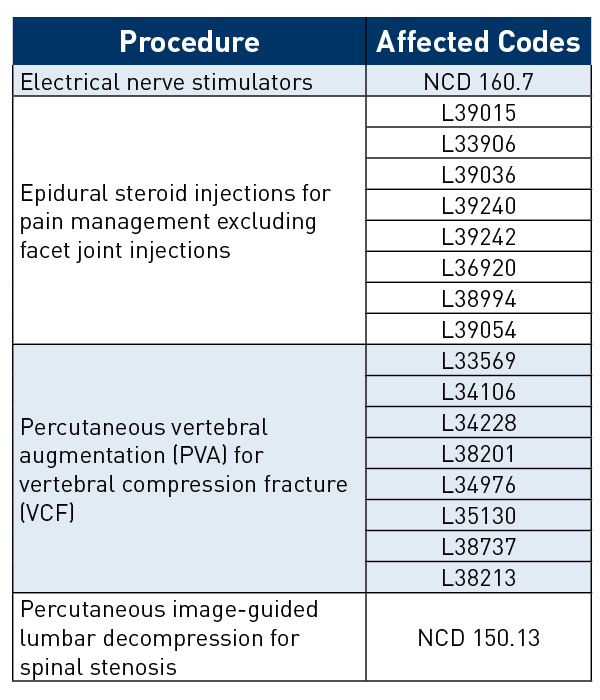
Providers will be able to choose to submit to the prior authorization requests up front or send claims through pre-payment medical review, the latter of which could cause delays in reimbursement. Contractors will be financially rewarded based on cost savings, which has raised concerns about potential denials for medically appropriate care. Organizations like the American Osteopathic Association also have shared concerns about implementation and additional provider burden.
A fact sheet is available to provide more program details.
Pain Medicine Coalition
ASRA Pain Medicine and the American Society of Anesthesiologists (ASA) established the Pain Medicine Coalition (PMC) in 2024 to advance the common goals of the pain medicine community and to advocate for responsible pain care for all patients. The International Pain & Spine Intervention Society (IPSIS) and the American Academy of Physical Medicine and Rehabilitation (AAPM&R) are also members of the coalition. Its purpose is to develop, monitor, and advocate for responsible health care policy for people who experience both acute and chronic pain and the physicians who support them. They do their work through clinical care, education addressing quality of care, access to care, public and professional education, and research.
Read more about the Pain Medicine Coalition:
ASA and ASRA Pain Medicine: Speaking With One Voice
President’s Message: The Power of ASRA Pain Medicine Volunteers

Are You a Member of AMA?
The American Medical Association (AMA) is the nation's largest physician organization and works to advocate for key issues that matter in your practice such as prior authorization, Medicare reform, promoting physician-led work, and more. ASRA Pain Medicine works with the AMA to advocate for the issues that matter in your practice with representation in the AMA House of Delegates, the Relative Value Scale Update Committee, and the Current Procedural Terminology Committees. ASRA Pain Medicine provides expert information and testimony specific to regional anesthesia and acute and chronic pain.
Learn more about the benefits of membership in AMA.
Read the latest AMA news and sign up for news alerts at ama-assn.org.

Practice Management
Find more health policy information in our Practice Management Resource Center.