Advocacy is one of the three pillars of ASRA Pain Medicine's mission. ASRA Pain Medicine addresses this core purpose by advocating at the regulatory level in the best interest of our members and the patients they serve. (Note: ASRA Pain Medicine does not participate in political advocacy.)

The Latest Health Policy Updates
ASRA Pain Medicine Leads Push for Improved Intrathecal Therapy Access
AMA adopts resolution to restore direct delivery of compounded syringes to physician practices
On June 10, American Medical Association (AMA) Annual Meeting delegates adopted a resolution advocating for legislation that would allow compounded intrathecal medication syringes to be delivered directly to physicians’ practices for treated patients. ASRA Pain Medicine, the American Association of Neurological Surgeons, and the Congress of Neurological Surgeons coauthored Resolution 203, titled "Compounded Syringe Delivery to Physician Practices for Intrathecal Therapy,” which received strong multispecialty support.
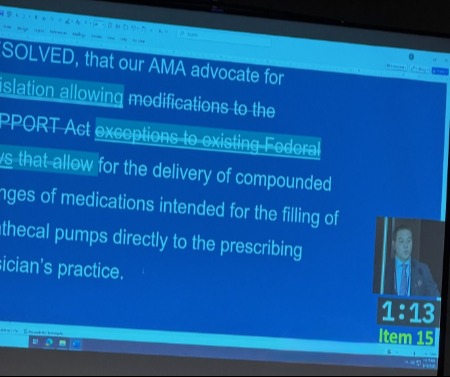
Dr. Gary Schwartz testified in support of the need to restore access to safe and effective care for patients receiving intrathecal pain therapies.
The process of delivering compounded syringes directly to physician practices was standard prior to the 2018 SUPPORT Act. That law, which was designed to prevent practitioners from stocking controlled substances for “general dispensing to patients,” inadvertently made it illegal to deliver controlled substances to physicians for use in intrathecal pain pump devices as well. Patients now have to personally receive and transport syringes of controlled substances to their appointments, creating safety, logistical, and compliance challenges for patients and providers.
Dr. Gary Schwartz, ASRA Pain Medicine delegate to the AMA, testified in support of the need to restore access to safe and effective care for patients receiving intrathecal pain therapies. Intrathecal drug delivery offers many benefits for patients with chronic conditions, including the ability to use smaller, targeted dosing and fewer systemic adverse effects.
“An estimated 100,000 patients rely on intrathecal pain pumps,” Schwartz said. “By creating this added hurdle, patients are experiencing delays, receiving inadequate pain control, and even experiencing serious adverse events, all of which would be avoided by direct delivery of compounded syringes for intrathecal therapies.”
The AMA has previously communicated the need for a solution to federal agencies, including the Drug Enforcement Administration and the Department of Justice, but both agencies responded that only Congress can resolve the issue.
Some testimony raised concerns that the change could open the door to abuses similar to controversial practices like “white bagging,” where insurers control drug distribution in ways that can affect patient safety and inventory management. The final resolution was amended to remove specific references to the SUPPORT Act while keeping the goal intact, which broadened support.
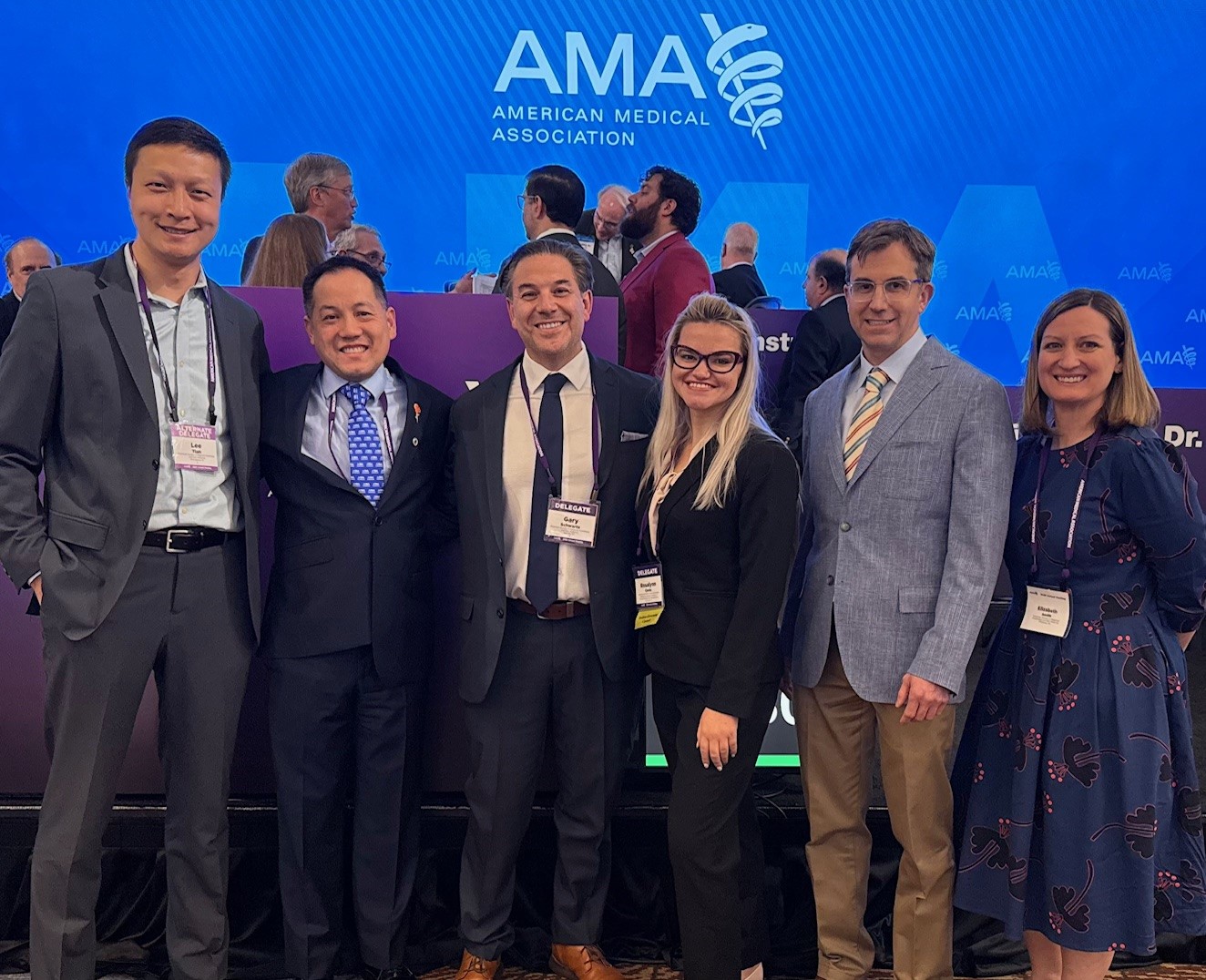
Lee Tian, MD, Richard Chou, MD, MBA, CPE, FACHE, Gary Schwartz, MD, Rosalynn Conic, MD, PhD, MPH, Immediate Past President David Provenzano, MD, and Executive Director Elizabeth Smith attended the AMA House of Delegates meeting held June 6-11 in Chicago, IL.
“This resolution is a critical win for pain medicine physicians and, more importantly, for the patients who rely on these medications,” Schwartz said. “We are thankful for the support of our partner organizations in advancing this key patient care issue.”
ASRA Pain Medicine has had a seat in the House of Delegates since 2022. In addition to Schwartz, ASRA Pain Medicine Members Richard Chou, MD, Lee Tian, MD, Rosalynn Conic, MD, Immediate Past President David Provenzano, MD, and Executive Director Elizabeth Smith attended the meeting held June 6-11 in Chicago, IL.
Other highlights from the meeting included steps to fix prior authorization, lead health care reform, and eliminate redundant compliance training, as well as the election of Willie Underwood III, MD, MSc, MPH, as president-elect.
Pain Medicine Coalition
ASRA Pain Medicine and the American Society of Anesthesiologists (ASA) established the Pain Medicine Coalition (PMC) in 2024 to advance the common goals of the pain medicine community and to advocate for responsible pain care for all patients. The International Pain & Spine Intervention Society (IPSIS) and the American Academy of Physical Medicine and Rehabilitation (AAPM&R) are also members of the coalition. Its purpose is to develop, monitor, and advocate for responsible health care policy for people who experience both acute and chronic pain and the physicians who support them. They do their work through clinical care, education addressing quality of care, access to care, public and professional education, and research.
Read more about the Pain Medicine Coalition:
ASA and ASRA Pain Medicine: Speaking With One Voice
President’s Message: The Power of ASRA Pain Medicine Volunteers
Are You a Member of AMA?
The American Medical Association (AMA) is the nation's largest physician organization and works to advocate for key issues that matter in your practice such as prior authorization, Medicare reform, promoting physician-led work, and more. ASRA Pain Medicine works with the AMA to advocate for the issues that matter in your practice with representation in the AMA House of Delegates, the Relative Value Scale Update Committee, and the Current Procedural Terminology Committees. ASRA Pain Medicine provides expert information and testimony specific to regional anesthesia and acute and chronic pain.
Learn more about the benefits of membership in AMA.
Read the latest AMA news and sign up for news alerts at ama-assn.org.

Practice Management
Find more health policy information in our Practice Management Resource Center.